The intersection of mechanical engineering and intelligence tradecraft produced some of the twentieth century's most remarkable devices. From portable cipher machines carried by infantry units to miniature recorders concealed in jacket pockets, the material culture of signals intelligence tells a story that classified documents alone cannot. This essay surveys the relevant holdings in The Wonder Room Collection and places them within the broader history of Cold War intelligence technology.
Cipher Machines: The M-209 and Its Legacy
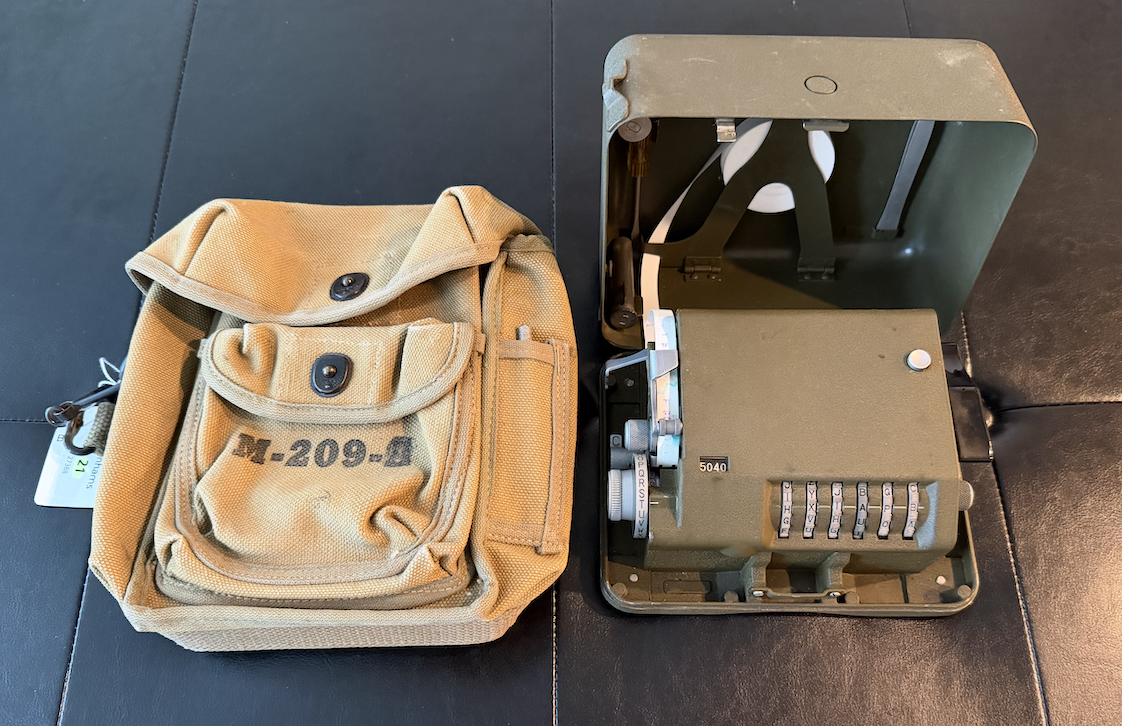
The M-209 cipher machine, designed by the Swedish cryptographer Boris Hagelin and manufactured by Smith Corona in the United States, was the most widely produced cipher device in American military history. Over 140,000 units were built between 1942 and 1945. The machine uses a system of six keyed wheels whose lugs interact with a rotating drum to produce polyalphabetic substitution ciphertext. Each wheel carries a different number of pins (17, 19, 21, 23, 25, and 26), yielding a theoretical key space vast enough for tactical field communications.
The Wonder Room Collection holds two M-209 variants: an M-209-B acquired from the Enigma Museum, and an M-209 Converter model acquired through Bonhams. The B variant represented a refinement of the original design with improved mechanical reliability for field conditions. Despite the fact that German cryptanalysts of Inspectorate 7/VI were able to break M-209 traffic regularly from 1943 onward, the machine's portability and speed made it invaluable for tactical communications where the intelligence value of messages degraded within hours.
Complementing these American machines is a Quante StSt-52, a Cold War-era West German telecommunications scrambling device. Manufactured by Quante AG, the StSt-52 secured voice communications for military and government channels during the decades following the war. It represents the direct lineage from wartime cipher technology into the electronic scrambling systems of the Cold War.
Covert Recording: From Wire to Tape
The Nagra SN (Serie Noire) is among the most significant artifacts in the collection's intelligence holdings. Commissioned by the U.S. government in the late 1960s and manufactured by Kudelski SA in Switzerland, the Nagra SN was engineered to the highest possible standards of miniaturization and audio fidelity. Fewer than 5,000 were produced. The device uses a reel-to-reel tape mechanism so precisely manufactured that it could record conversations for extended periods while concealed on a person. Among intelligence equipment collectors, the Nagra SN is considered one of the most desirable items in the field.
Preceding the Nagra SN by nearly two decades, the Minifon wire recorder represents an earlier generation of covert recording technology. Developed in Germany in the early 1950s by Protona GmbH, the Minifon recorded audio onto a spool of thin steel wire. It could capture up to two hours of conversation. Intelligence agencies on both sides of the Iron Curtain employed the Minifon extensively during the 1950s before magnetic tape technology became sufficiently miniaturized.
The Mohawk Midgetape rounds out the collection's recording holdings as one of the smallest reel-to-reel tape recorders ever produced. Designed explicitly for body-worn surveillance applications, it bridged the gap between the Minifon's wire recording and the Nagra SN's precision tape technology. The Uher portable recorder, also in the collection, served dual roles in broadcast journalism and intelligence applications, its West German manufacture reflecting the country's position at the geographic and technological crossroads of the Cold War.
Subminiature Cameras: Eyes of the Cold War
The Minox B subminiature camera is perhaps the single most iconic espionage artifact of the Cold War. Manufactured in Germany from 1958 to 1972, the Minox B uses 9.2mm film in a cassette small enough to be palmed in one hand. Its optical quality was sufficient to photograph documents with readable text, making it the standard-issue camera for intelligence officers on both sides. John Walker, Aldrich Ames, and numerous other known spies used Minox cameras to photograph classified materials.
The collection holds multiple Minox cameras and accessories, including the Minox B and a broader collection described as "A Mini Mix of Marvellous Minox Miniature," acquired through LiveAuctioneers. This grouping illustrates the Minox platform's evolution across multiple models produced from the original 1936 design onward. Walter Zapp, who conceived the Minox in Latvia, intended it as a civilian pocket camera; its adoption by intelligence services was an unintended consequence of its extraordinary miniaturization.
Representing the Soviet perspective, a Kiev subminiature camera provides a direct counterpart to the Western Minox. Produced in Ukraine at the Arsenal factory, Soviet subminiature cameras served the KGB and GRU for covert document photography. The quality of Soviet optical engineering, while sometimes dismissed in the West, was in fact highly capable for intelligence applications.
A Minolta Mini 16 slide projector completes the optical intelligence picture. While not a camera itself, the projector served the critical function of viewing and analyzing the tiny transparencies produced by subminiature cameras, an essential step in the intelligence processing chain.
The Gibson Girl and Field Communications
Not all signals intelligence equipment was covert. The SCR-578 emergency radio transmitter, known universally as the "Gibson Girl" for its distinctive hourglass shape, was a survival device rather than an espionage tool. Designed so that a downed airman could grip it between the knees while cranking the hand generator, it transmitted an SOS signal on the international distress frequency of 500 kHz. The Gibson Girl is credited with saving thousands of aircrew lives during World War II. The collection's example, acquired through Bonhams, connects the overt and covert dimensions of military radio technology.
A WWI German command staff telephone in the collection extends the signals timeline backward to the Great War, when field telephony first became critical to coordinating the complex operations of trench warfare. This instrument, connecting command posts to forward observation positions, represents the industrialization of military communications that would evolve, over subsequent decades, into the cipher machines and covert devices described above.
Collecting Considerations
Intelligence equipment occupies a specialized niche in the broader militaria and technology collecting markets. Authenticity verification relies on serial numbers, manufacturer markings, known production quantities, and physical examination of components. The M-209, with 140,000 units produced, is relatively accessible; the Nagra SN, at under 5,000 units, commands significant premiums. Provenance documentation — particularly any evidence of actual intelligence service use — dramatically affects both historical interest and market value, though such documentation is by nature rare for equipment designed to operate in secret.