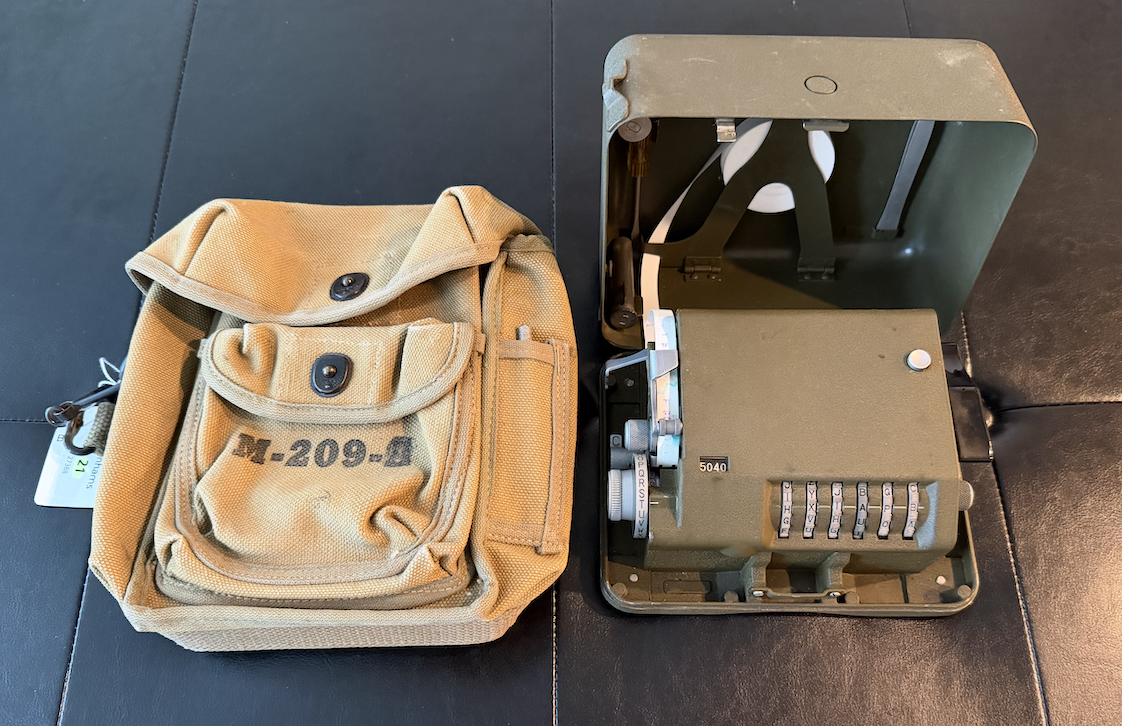
M-209-B Cipher Machine with M-209-A Canvas (Bonhams)
M-209-B cipher machine with original M-209-A canvas carry case. US Army WWII-era field encryption device, Boris Hagelin design. The accompanying canvas is marked M-209-A, indicating a mixed-variant field kit. Acquired through Bonhams.
Historical Context
The M-209-B cipher machine was a portable, mechanical encryption device designed by Swedish cryptographer Boris Hagelin and adopted by the U.S. Army in 1943. Operating on a pin-and-lug wheel mechanism, it could encrypt and print messages in the field without any external power source. Over 140,000 units were manufactured — making it the most widely produced cipher machine in American military history — and it served in every theater of World War II and through the Korean War. The M-209-A canvas carry case present with this example bears the earlier variant designation, reflecting the mixed fielding of components across production runs.
The M-209 remains directly relevant to contemporary discussions of cryptographic security and operational secrecy. German cryptanalysts of Inspectorate 7/VI were breaking M-209 traffic regularly by 1943, a fact kept classified for decades — a sobering early precedent for the gap between fielded encryption standards and real-world adversarial capability. Today that same tension plays out in debates over end-to-end encryption, government backdoors, and the classification of zero-day vulnerabilities. The machine on display is not a relic of solved problems; it is a physical argument for why cryptographic humility matters.